
Andy: Hello. How are you doing?
I'm doing just fine, thanks for asking. What about you and how are things in Sweden overall?

Andy: Everything is good here. Still cold, but I'm sure it is pretty cold up in Finland too, right?
Yes, it is. Fortunately, spring is right around the corner, so that's a cool thing because it was such a long winter here in Finland and, I assume, in Sweden as well.
Andy: Yes, it's been a very long winter here too. Crazy, man. In a couple of days, it's going to be nicer here.
BACK TO THE '80S SOUND
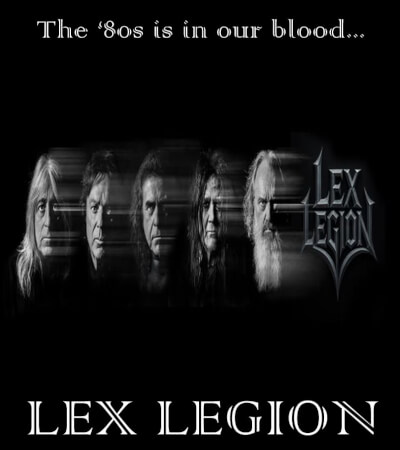
Same here. Anyway, the main subject of our conversation is, of course, your new band named Lex Legion. The band brings together several members from the classic King Diamond era. What finally made 2026 the right moment to form this band?
Andy: The story is kind of long because it started back in 2008 when me and Pete talked about maybe doing something together. Maybe just put together an album and start writing some songs. We started to write a few songs back in 2008. We had a few riffs here and there, and then it just turned into nothing because we were kind of busy with other things. Then, many years later, I think this was during the pandemic, Pete continued writing a few riffs, and he played some of the riffs and songs for Mikkey, who thought, "This sounds really good. I want to be a part of this."
Then Pete said, "Yes, maybe we should ask Andy too, but I guess he's too busy with King Diamond and everything." At the time, during the pandemic, nothing was really happening. They called me and asked me if I wanted to join that project. I said, sure, man. We're doing nothing really with King Diamond because we have a pandemic now, and let's do it. During that time, we put together a few more songs, and that's how it started.
Then Hal Patino was also asked during that period. It took us about, I don't know, many years. If you count it from 2008 up until now, that's many years. For the final maybe three or four years, we put everything together. In the very end, everything went quite fast. We got a record deal, and everything was really smooth in the very end.
You have described the album as having elements of everything. How did you balance nostalgia with creating something future facing?
Andy: I think when I say, "has a little bit of everything," we are old-school guys, but we still want a modern sound. Our roots and our metal and rock and roll schooling comes from, I would say, the late '70s, the '80s. That's our school. It's definitely in the '80s, I would say. Listening to all the cool bands that were around at the time, Ozzy Osbourne and a lot of great guitarists from that era. Both me and Pete, the other guitarist, are from that school, and that's how we write riffs.
Sometimes with a little mystic ingredient in the riffs. Sometimes even you can hear maybe some classical stuff too, but mainly aggressive heavy metal [*chuckles*], but still with the roots in the '80s.
How did working with Nils K. Rue influence the songwriting compared to your past collaborations?
Andy: I worked with Nils 15 years ago in an experimental thing we did, just putting riffs together, sending it to each other. At that time, it was a band called... God, man. Oh, God, that was just-- X-World/5 was the band called at the time. That was an experimental thing we did when we just sent riffs to each other. Involved in that project was Reeves Gabrels, who used to play with David Bowie, actually, and Tin Machine. Also, Magnus Rosén, who was the bass player for Hammerfall for many years.

We had a drummer from Los Angeles called Stefan, Swedish guy, who lives in Los Angeles. We sent small bits and pieces to each other and then put it together. That was really cool to try that out, but this is totally different from what we do now with Lex Legion. This is more defined, more controlled. Everything is the way we want it now. Working with Nils is awesome because he has a great sense of melodies and great voice, great lyrics. Everything is just perfect with that. Me and Pete, we work so well together when we write riffs and write songs.
He can come up with the start of a riff, and I can continue with a verse riff or the other way around. It just works out fine. Then Mikkey comes in doing some arrangement changes in the songs. He's really good at that. Then with Hal Patino's bass playing on top, it's just the icing on the cake, whatever you call it. It's just finishing everything in a very good way. It works out fine. To be honest with you, we are already working on some riffs for the second album.
Oh, wow... you guys are on fire.
Andy: Yes, exactly. We're very creative and productive in this sense. I'm not going to say too much because people always get disappointed when you talk too much about that. Here, it just flows in a very good way. Hopefully, we'll have a second album out by, well, we'll see, next summer maybe.
You never know.
Andy: We'll see. You never know. We'll see. We got four or five songs with the riffs already for that second album.
Cool. The chemistry between you and Pete Blakk goes back decades. How did that dynamic evolve in Lex Legion?
Andy: We got a little bit older [*laughs*]. When Pete comes into the studio, we just pick up the guitars, and we sit around and just work out riffs, as I said earlier. It never really stopped. While we were working on the Them album, for example, we stayed in the studio for several months working on solos and stuff. It feels like we never stopped doing that. It's weird. We had a few years when we didn't even meet or talk to each other, because I was busy with things, and he was busy with other things.
When we met back in 2008, it felt like we were never really apart. When he comes into the studio, just pick up the guitars, as I said earlier, we start riffing, and it just feels so natural, the way we do it. It's a great cooperation, I would say. Also, when we write the riffs, we know that it will fit Mikkey and Hal and Nils well, too. Nils can sing over pretty much anything, because he will make up a great melody that will fit. If there is something that needs to be adjusted, he just lets us know, and we try something different.

SOUNDING STRAIGHTFORWARD IS MORE
You've mentioned the song arrangements are "less progressive and more straightforward." Was that a conscious artistic decision from the start?
Andy: Well, we didn't want to make it too complicated. We want to have music that, first, we like, but we also want it to be easy for the audience to understand and listen to, as well. Then we can sneak in a few elements here and there, of course, with backbeats and some weird stuff. I think it gets tiring to have that all the way through in every song. Just like weird things going on and backbeats and a lot of progressive things, that's kind of, wow, man. In my opinion, one of the best bands in the world is AC/DC because they're so straightforward. Everything is easy to listen to. You should be able to, even when you're 80 years old, to play it live. You know what I'm saying? [*laughs*] You don't want it to be too complicated. You want it to be like an easygoing thing that you can listen to whenever you feel like it. Then again, some elements are in there that makes it interesting to listen to. I think we achieved a pretty good balance here. Mikkey is really good at coming in and saying, maybe we can just add that little thing here. Maybe I will change the rhythms around a little bit here to make it a little more interesting. Sure, that's exactly what we expect from Mikkey. Perfect.
What was the writing process between you, Blakk, and the rest of the band? Was it a more collaborative or more individual-driven thing?
Andy: No, it's actually both because sometimes I come up with a whole song, with all the riffs in one song. Sometimes the same thing with Pete. He comes up with all the riffs of a song, but it's just as often that he has a great start riff. I complete that with a verse riff and the other way around. I come up with the start riff, and he can maybe do the chorus riff or the rhythm guitars on the solo parts and stuff like that. Then we also have some ideas with the drums that we can put a drum machine on just to get a feel of how it will work. If it doesn't sound the right way, we just try to find something different. We complete each other in a very good way, in that sense, I would say.
Having played on Individual Thought Patterns with Death, how does your approach differ when working in a band like Lex Legion?
Andy: Well, when we worked with Death, that was a little different thing because they asked me to, first, do the solos or the half of the album or half of the songs. I was there for 10 days doing my thing. I had a great time with them. They were great guys, Chuck and everyone else. They really took care of me. At the end of the session, they actually asked me if I wanted to join the band for the upcoming tours and stuff. I was so busy with everything else at that time, with my own solo project that later turned out to be Illwill. I don't know if you've ever heard about that.
That was a project I had together with Snowy Shaw and Sharlee D'Angelo. It's called Illwill. I was expecting my second child that year, too. I was tired of touring there. I just had to kindly decline that question from them. They were great guys. I had a great time in the studio. That was different because I was only there to do my solos, as I see it. In Lex Legion, this is more like a band where we all are involved, just equal and just as much. We do different things, but everyone is involved.
LEX LEGION IS NOT KING DIAMOND
Tracks like "Sleep Eternally" hit hard right away, and people really dug it when they got to hear it. Was it important for you to make a strong first impression with the debut single?
Andy: We actually asked the record company what they thought would be the first single to release. We went through it. We had a few suggestions, too, of course, but we all agreed on, at the very end, that this would be the first single. They also came up with the suggestion of the second one, which we all agreed on. I'm not going to say which one it is if you don't know it already, but you'll hear it in a couple of weeks because the second single is going to be released, I don't know, somewhere in May, I believe.
People who have heard that say, "No, I like the second one even better." [*laughs*] The response has been absolutely overwhelming. I also think it's important to say here that the songs we write and the songs from my side of it, it's nothing that-- It's no leftovers from the King Diamond songwriting, if you know what I mean, from the library I have with King Diamond. This is completely different and has nothing to do with King Diamond in that sense. King Diamond is King Diamond, and I write songs for King Diamond, and then I write songs for Lex Legion. I don't want people to believe that, oh, he has some songs that were intended for King Diamond that he's using here. No, not at all. It's not the other way around, either. It's two very different and separate things.

I think it's really important to keep those two bands completely separated from each other.
Andy: Yes, I think that's very important.
We already discussed Mikkey a little bit, but how would you say his drumming shaped the overall sound and energy of the album?
Andy: Oh, man, without Mikkey, it wouldn't be the same, of course. We have known each other for, I don't know, 45 years, [*laughs*] so you know what to expect, pretty much. He is also a great arranger. He comes in and has suggestions of, "Maybe you should extend that chorus, for example, just a little bit," or "Take this out, and I can do some really cool drumming on that." That changed the part of the song quite a bit. What's important, too, is that you can actually hear it's Mikkey playing, because I really think you can hear Mikkey playing. It's his style and his special thing that he always does with the ride. His playing in general, you can hear his rolls, and you can hear his cymbal playing and all that. I think that's really important to have a personality, in that sense, both in the studio and on the record.
We all contribute. We're all contributing with our own personal styles to this album.
It's been said that Lex Legion draws comparisons to classic acts like Iron Maiden and Queensrÿche. How do you feel about those influences being highlighted?
Andy: I think that's fine because, yes, we are '80s-ish guys. We were born and raised with '80s-style music. I think that's absolutely fine. You can probably find influences and elements from everything we have been doing since the early '80s. Then you can hear probably things that would be influenced by Judas Priest, Ozzy Osbourne. Some people even think that, oh, you can maybe hear some King Diamond stuff in there, too. That's, of course, very natural because that's our school. That's fine. The same with Queensrÿche, as you mentioned. That's also the thing. You could probably hear some elements there.
The '80s are in your blood so to speak.
Andy: Yes, exactly, it's in our blood. [*laughs*]
There's talk of a "big hole" in the metal scene. What do you think is missing in modern heavy metal that Lex Legion aims to bring back?
Andy: That's funny that you say that because there is a lot of people who are saying that Lex Legion fills that gap of something that people have been missing. It's cool riffs, aggressive, and still one leg in the '80s. With the melodies, the aggression kind of thing, it's a good combination of everything. Then we just put it in a blender kind of thing and made it a little more modern. Sound-wise, we didn't make it too extreme. We don't, for example, use heavy drop tuning and stuff like that that most bands do nowadays.

We keep it pretty straight and simple. Just that mix of everything here, that's what makes Lex Legion, I think. I really think that we can fill a gap in the music business right now with the Lex Legion, because it has some really cool elements of everything.
You recorded the album at your studio in Varberg. How did that environment influence the production and the tone of the album?
And: I don't know if that really influenced me, but I've got a great studio here, Sonic Train Studios, which I have had here for 20 years. Before that, I was in a place in Gothenburg for 15 years. I had a lot of bands here, everything from Hammerfall to Arch Enemy and At The Gates and whatever. When people come here, they say that it's a very nice and relaxed environment, which is really important, of course. When I come to the studio, I'm usually very creative, because it is nice and quiet, it's relaxing.
Of course, that helps, too, with the inspiration. The same when Pete and Mikkey come in here. They feel like it's very creative to be here. It's a creative environment, for sure. In general, to be in a studio where you know that you can create music and document and record music, in my opinion, that's one of the best things in the world.
A MUSICAL JOURNEY
The album is described as a journey. Did you approach it conceptually, like telling a story across tracks?
Andy: Not really. Of course, there are things in the songs that would connect to the other songs. Some words and sentences here and there, but that's not the intention we had doing it. It's like independent songs. I would call it more like that. Then again, I think the music on the album has a red line through everything. I think the album is also put together in a good way. The sequence of the songs, for example, makes it-- How much have you heard of it?
Just one song so far, "Sleep Eternally", but that's about it.
Andy: Okay. I'll see if I can connect you with the record label, because they have a special way of doing it. Maybe you can get a chance to listen to some more stuff.
That would be great.
Andy: Yes. I would say, musically, it's a journey, because all the songs have different elements in it. If you listen to the album from the beginning to the end, you will understand what I'm saying. It's like a roller coaster. Some songs have more aggressiveness, and some songs are a little more laid back. When you listen to the album from the beginning to the end, it's like, wow. It all comes together in a good way, I think. It's definitely a musical journey. When you get a chance, especially when you listen to the ending, I'm not going to say too much about this, but we have a pretty fast song as the next to last song.
Then at the very end of the album, there is a quite different song, but you will recognize some parts of it, the style of it, you know what I'm saying? I'm not going to say too much [*laughs*] because I don't want to spoil anything for the audience. You will understand when you hear it. The contrasts between the songs are really good on the album, and the way it's put together, too. That's also a thing that Mikkey is really good at. We talked about it. We knew the first and maybe the second song. I also knew which one was going to be the last song on the album.
Then Mikkey had a really good suggestion because he said, okay, put it this way, put it this way, and think about this, think about this, because he was really good at that in Motörhead. He put together the sequence on the album on the last, I don't know, 15 years or whatever, you know? I think it's the perfect sequence on the Lex Legion album here, which we're all very happy with.
"THEY LOVE THIS STUFF"
That's very nice to hear, actually. I'm really looking forward to hearing this whole album at some point, for sure. With such a legacy behind you, did you feel any pressure from the long-time King Diamond fans while creating this record?
Andy: Well, fortunately, the first reactions we had from the first song, they've been extremely happy, people who like this kind of music. Even though, as I said earlier, this has nothing to do with King Diamond, except for we're former members that play together. Old friends having fun and writing some good songs. As I said, from the first reactions, from the fans we have, and we're talking then fans from Motörhead, King Diamond, Scorpions, even Dokken fans who heard this stuff, they love this stuff. They love this stuff.
I don't think I've seen any really negative reviews anywhere. People have just been crazy about this. That's only from the first song. Once they hear the next thing, I think they're going to like that just as much, hopefully.
In general, we write songs the way we would like to have it. If people like it, it's great. What can you say? Very thankful for people who like it, definitely.
Alright. I have just one more question left for you. When looking ahead to touring in 2027, how do you envision translating Lex Legion's studio sound to a live setting?
Andy: Oh, I don't really know that yet. We haven't really talked about that. It's kind of far in the future. The good thing here is that it's a guitar-based band, so it's going to be a lot of guitars, of course. We have very few keyboard things on the album. It's nothing that we really need to have when we play live. It's hard to say, but we're going to try to make the sound live as close as possible to what you hear on the album, of course.
Yes. Of course, it's very important if you can translate your studio sound into a live setting. In the studio, you can play around with so many different things with all that modern technology that you have around you there. But translating studio sound to a live setting is a whole different thing...
Andy: Yes, exactly. If you overproduce your albums, it's going to be hard to translate that live, of course. When you have a lot of keyboards and vocals and choirs and stuff going on, it's going to be very hard to do that, of course. This is still pretty basic. It's two guitars, bass, drums, and a great vocalist. Then, of course, he's doing some overdubs with choirs and stuff on the album. We also can do some backing vocals to support Nils live.
The keyboard parts we have, that's nothing that would change the whole world if you don't hear them live, or what we can do is have it on sequence as many bands do with the click track for the few keyboard things we have. We can have it on sequence in the background and play along with that. We'll see. We haven't really discussed that yet. We're going to, of course, try to make it as close as possible sound-wise.
When the time comes, do you believe that you are going to arrange a record release party after the album's out there and available for everyone?
Andy: We haven't really talked about that. We should. Mikkey, he's very busy with Scorpions this year. I don't really know if he's going to be home that day. What we're going to do, we're going to be down at Sweden Rock Festival on the 5th of June. We're going to have a signing session. That's just a week before the album is released. People can order the vinyl and the CDs, and they get a signed photo and stuff to do it. At that time, we can meet and maybe have a few beers. We'll see.
Well Andy, that's all I had in mind for this pleasant conversation with you, so thanks a lot for your time, and for having this chat with me. I really wish all the best for you with Lex Legion in the future¬—and, of course, I'm also hoping to see you live somewhere at some point as well.
Andy: Thank you very much... and yes, I really hope so too. Just let me know if you need anything else from me. If you don't hear from me within the next couple of days with the connection to the record company, just remind me about it, and I'll see if they can set you up with a preview listening or whatever they do. I don't know that, but I'm going to check that. Just remind me.
Absolutely! I would really appreciate that for sure.
Andy: Sure. Let's talk about that and have a great day.
Yes, have a great day in Sweden too. The summer is close already, so let's just enjoy this sunny spring weather meanwhile.
Andy: Exactly. Super. Thank you very much. Take care, man.